Mastering Mining Algorithms

In the dynamic world of blockchain and cryptocurrency, the integrity and security of decentralized networks hinge on a critical component: mining algorithms. These sophisticated cryptographic puzzles are the bedrock upon which new blocks of transactions are verified, added to the blockchain, and secured against manipulation. Far from being mere computational tasks, they represent the complex rules and mathematical challenges that miners must solve, consuming significant computational power in a process often referred to as "proof of work" (PoW). It is through this arduous process that consensus is achieved, new digital assets are minted, and the entire ecosystem remains robust and trustworthy.
The journey of a transaction from initiation to finalization on a blockchain is intricately tied to these algorithms. They dictate how data is hashed, what conditions must be met for a block to be valid, and ultimately, how participants are rewarded for their computational efforts. Understanding these underlying mechanisms is crucial not only for miners seeking profitability but also for anyone looking to grasp the fundamental principles of decentralized finance and digital asset security.
Different cryptocurrencies employ distinct mining algorithms, each designed with specific goals in mind, whether it's to promote decentralization, resist specialized hardware, or optimize for energy efficiency. This diversity reflects the ongoing innovation within the blockchain space, as developers continuously seek to enhance the security, accessibility, and scalability of their networks. The choice of algorithm has profound implications for a cryptocurrency's distribution, its vulnerability to attacks, and its overall economic model.
This exploration delves into the intricacies of various mining algorithms, examining their technical specifications, the cryptocurrencies that utilize them, and their broader impact on the blockchain ecosystem. From the pioneering SHA-256 of Bitcoin to more memory-intensive or ASIC-resistant variants, we will uncover how these algorithms shape the competitive landscape of mining and the very fabric of digital trust.
What Are Mining Algorithms?

At their core, mining algorithms are cryptographic hash functions that serve as the computational challenge in a proof-of-work system. When a miner attempts to create a new block, they must gather a set of pending transactions, combine them with a unique numerical value called a nonce, and hash this entire data set. The goal is to find a nonce that, when hashed with the block data, produces a hash output (a string of characters) that falls below a specific target value. This target value is dynamically adjusted by the network to control the block creation time, ensuring consistency regardless of the total computational power (hash rate) of the network.
The process is inherently probabilistic; miners essentially guess random nonces until one yields a valid hash. This "guessing" is computationally intensive and requires significant processing power, which is why it's often described as a race among miners. The first miner to find a valid hash broadcasts their newly found block to the network. Other nodes then verify the block's validity by quickly recalculating the hash and checking if it meets the target. If valid, the block is added to the blockchain, and the successful miner receives a block reward, typically consisting of newly minted cryptocurrency and transaction fees.
The Core Function of Mining Algorithms
The primary function of mining algorithms is to secure the network. By making block creation computationally difficult, they prevent malicious actors from easily manipulating the blockchain. To alter a past transaction, an attacker would need to re-mine not only that block but every subsequent block, which would require an insurmountable amount of computational power, making such an attack economically unfeasible for most decentralized networks. This computational hurdle is what gives rise to the "proof of work" concept, where the effort expended to find a valid hash serves as undeniable proof of the miner's contribution and adherence to network rules.
Mining Algorithms and Blockchain Security
The cryptographic properties of mining algorithms are foundational to blockchain security. They rely on the one-way nature of hash functions: it's easy to compute a hash from an input, but practically impossible to reverse-engineer the input from a given hash. Furthermore, even a minuscule change to the input data results in a completely different hash output, ensuring data integrity. This makes tampering with transactions extremely difficult, as any alteration would invalidate the block's hash, requiring re-mining. The ongoing competition among miners also strengthens network security by continually adding computational power, increasing the cost of any potential attack.
Prominent Proof of Work Mining Algorithms
The landscape of cryptocurrencies is diverse, and with that diversity comes a variety of mining algorithms, each with its unique characteristics and design philosophies.
SHA-256: The Bitcoin Standard
Perhaps the most famous of all mining algorithms, SHA-256 (Secure Hash Algorithm 256-bit) is the backbone of Bitcoin and many other cryptocurrencies, including Bitcoin Cash (BCH) and some older altcoins. It is a highly efficient cryptographic hash function that produces a fixed-size, 256-bit (32-byte) hash value. SHA-256 is known for its computational intensity, which has led to the development of highly specialized hardware called ASICs (Application-Specific Integrated Circuits). These machines are designed solely for SHA-256 mining, offering significantly higher hash rates and energy efficiency compared to general-purpose CPUs or GPUs. While highly secure and robust, the prevalence of ASICs in SHA-256 mining has led to concerns about mining centralization, as only those with access to this specialized hardware can compete effectively.
Scrypt: Memory-Hard Alternatives
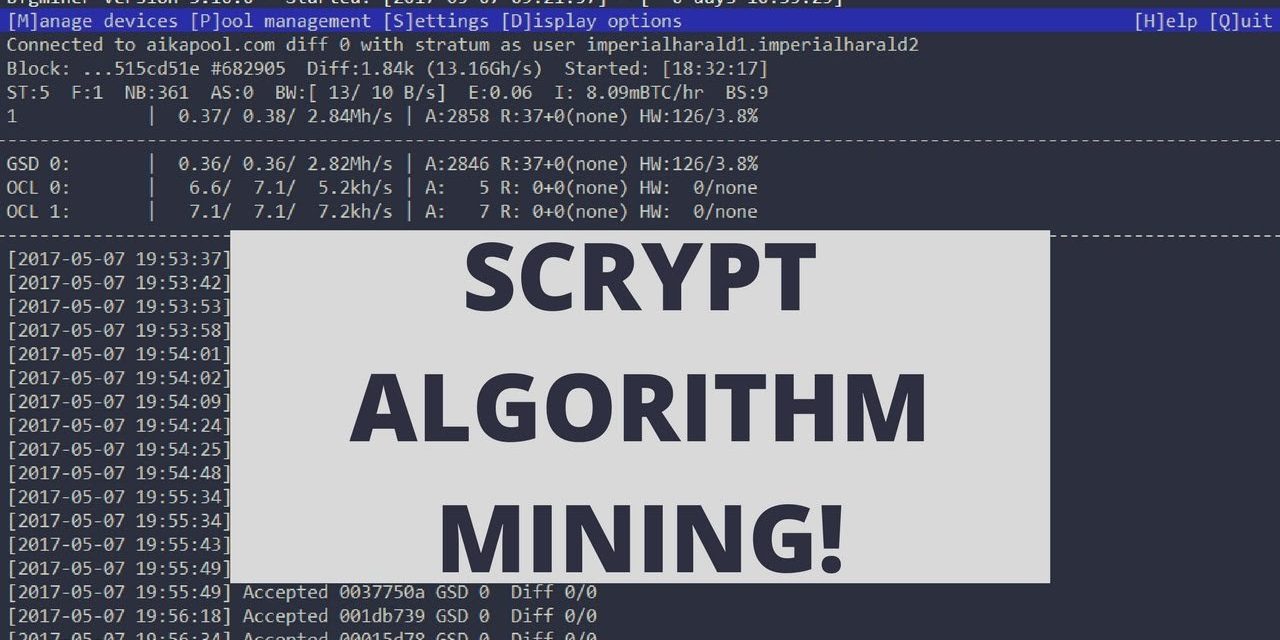
Developed by Colin Percival, Scrypt was initially conceived as a Proof-of-Work function for the Tarsnap online backup system, designed to be computationally expensive for attackers without being excessively resource-intensive for legitimate users. In the crypto world, Litecoin was the first major cryptocurrency to adopt Scrypt as its mining algorithm, followed by Dogecoin and others. Unlike SHA-256, Scrypt is a memory-hard algorithm, meaning it requires significant amounts of RAM in addition to computational power. This design choice was intended to resist ASIC development, as integrating large amounts of high-speed memory directly onto an ASIC chip is more challenging and expensive than simply optimizing for raw computational throughput. While ASICs for Scrypt have eventually been developed, they generally offer less of a performance advantage over GPUs compared to SHA-256 ASICs, contributing to a more diversified mining ecosystem for Scrypt-based coins.
Ethash and RandomX: ASIC Resistance
Ethereum, before its transition to Proof of Stake, famously used Ethash as its mining algorithm. Ethash is another memory-hard algorithm, designed specifically to be ASIC-resistant. It makes extensive use of a large dataset known as a "DAG" (Directed Acyclic Graph), which changes periodically. This DAG must be stored in the miner's GPU memory (VRAM). The sheer size of the DAG (growing over time) and the memory access patterns made it difficult for early ASICs to outperform GPUs efficiently. However, with time, specialized ASICs for Ethash did emerge, albeit less dominant than in the SHA-256 realm. The continuous challenge to maintain ASIC resistance highlights the arms race between algorithm designers and hardware manufacturers.
RandomX is a more recent and highly advanced mining algorithm used by Monero, among others. Its design represents a sophisticated attempt at achieving true ASIC resistance by making the mining process resemble general-purpose CPU computations. RandomX works by executing random code, using various CPU instructions, and extensive memory access. It dynamically generates program code and executes it within a sandboxed environment, making it incredibly difficult for ASICs to gain a significant advantage over high-end CPUs. This approach aims to promote decentralization by allowing anyone with a consumer-grade CPU to participate in mining, leveling the playing field and reducing the influence of large mining farms.
Equihash: A Unique Approach
Equihash is a mining algorithm based on the generalized birthday problem, first used by Zcash. It is also a memory-hard algorithm, but its memory requirements are different from Scrypt or Ethash. Equihash requires a substantial amount of RAM (gigabytes), and the computational complexity grows exponentially with reduced memory, making it inherently difficult to optimize for ASICs through brute-force computation. Its design focuses on parallelism and memory bandwidth, which favors general-purpose hardware like GPUs. While ASICs for Equihash have been developed, the algorithm's design has, to some extent, maintained a more diverse mining community.
Characteristics and Design Goals of Mining Algorithms

The design of effective mining algorithms involves balancing several critical characteristics to ensure network health, security, and decentralization.
Hash Function Properties
All mining algorithms rely on cryptographic hash functions that exhibit specific properties:
* Determinism: The same input always produces the same output hash.
* One-way function: It's computationally infeasible to reverse the process and determine the input from the hash output.
* Collision resistance: It's practically impossible to find two different inputs that produce the same hash output.
* Avalanche effect: A small change in the input should result in a drastically different output hash, preventing predictability.
These properties ensure the integrity and security of the blockchain data.
Difficulty Adjustment
A crucial feature of most PoW mining algorithms is their difficulty adjustment mechanism. The difficulty target is dynamically recalibrated by the network at regular intervals (e.g., every 2016 blocks for Bitcoin, roughly two weeks) to ensure that blocks are found at a consistent rate (e.g., approximately every 10 minutes for Bitcoin). If the total network hash rate increases (more miners join or existing miners upgrade hardware), the difficulty automatically increases, making it harder to find a valid hash and thus maintaining the target block time. Conversely, if the hash rate decreases, the difficulty decreases, ensuring blocks continue to be found. This self-regulating mechanism is vital for the stability and predictability of the blockchain network.
ASIC Resistance vs. Efficiency
A perpetual debate in the design of mining algorithms is the trade-off between ASIC resistance and raw computational efficiency. Algorithms like SHA-256 prioritize raw processing power, leading to highly efficient ASICs but potentially centralizing mining power in the hands of those who can afford and operate such specialized hardware. In contrast, memory-hard or CPU-bound algorithms like Scrypt, Ethash, and RandomX aim for ASIC resistance to promote a more decentralized mining environment, where individuals with consumer-grade hardware can participate. However, making an algorithm truly ASIC-resistant is an ongoing challenge, as hardware manufacturers constantly innovate. The goal of ASIC resistance is to prevent a monopoly on mining power, thereby safeguarding the network from potential 51% attacks and maintaining its decentralized ethos.
The Impact and Evolution of Mining Algorithms
The choice and design of mining algorithms have far-reaching implications, influencing everything from hardware development to environmental concerns and the future of blockchain technology.
Hardware Specialization and Centralization Concerns
The evolution of mining algorithms has directly driven the specialization of mining hardware. Initially, CPUs were used for mining. Then, GPUs took over due to their parallel processing capabilities. With algorithms like SHA-256, the relentless pursuit of efficiency led to the dominance of ASICs. While ASICs boost network security by making attacks incredibly costly, they also raise concerns about centralization. The high cost and limited availability of ASICs can concentrate mining power in large farms, potentially undermining the decentralized nature of cryptocurrencies. This concern has fueled the development of ASIC-resistant algorithms, aiming to keep mining accessible to a broader range of participants using more general-purpose hardware.
Energy Consumption and Sustainability
One of the most significant impacts of Proof of Work mining algorithms is their substantial energy consumption. The computational effort required to solve cryptographic puzzles translates into a considerable electricity demand. This has led to global discussions about the environmental footprint of cryptocurrencies, especially large ones like Bitcoin. While proponents argue that a significant portion of this energy comes from renewable sources or otherwise wasted energy, the sheer scale of consumption remains a point of contention. This environmental concern has been a major driver for the exploration and adoption of alternative consensus mechanisms, most notably Proof of Stake.
The Future Landscape of Mining Algorithms
The future of mining algorithms is likely to be characterized by continued innovation and adaptation. With the shift of major networks like Ethereum to Proof of Stake, the relevance of traditional PoW mining algorithms might diminish for some of the largest cryptocurrencies. However, PoW remains foundational for Bitcoin and many other projects. Future mining algorithms may focus more on:
- Improved Energy Efficiency: Developing algorithms that require less raw computation while maintaining security.
- Enhanced Decentralization: Continued efforts to design algorithms that are genuinely ASIC-resistant and favor commodity hardware, ensuring broader participation.
- Quantum Resistance: As quantum computing advances, designing algorithms that are resistant to quantum attacks will become increasingly important for long-term security.
- Hybrid Models: Blending PoW with elements of other consensus mechanisms to leverage the strengths of each.
The ongoing research and development in this area are crucial for the sustainability, security, and evolution of the decentralized digital economy.
Conclusion
Mining algorithms are the unsung heroes of the blockchain world, acting as the complex engines that drive security, verify transactions, and mint new cryptocurrency units. From Bitcoin's robust SHA-256 to Monero's CPU-friendly RandomX, each algorithm represents a unique approach to achieving decentralization, security, and resistance to centralization. Their design involves intricate trade-offs, particularly between raw computational efficiency and the desire for ASIC resistance, aiming to strike a balance that protects the network while maintaining accessibility.
While the energy consumption of Proof of Work algorithms remains a significant debate, their role in establishing robust, immutable ledgers cannot be understated. As the blockchain ecosystem continues to mature, the evolution of mining algorithms will undoubtedly adapt to new challenges, pushing the boundaries of cryptographic design and shaping the future of decentralized finance. Understanding these fundamental components is key to appreciating the engineering marvels that underpin the digital economy.